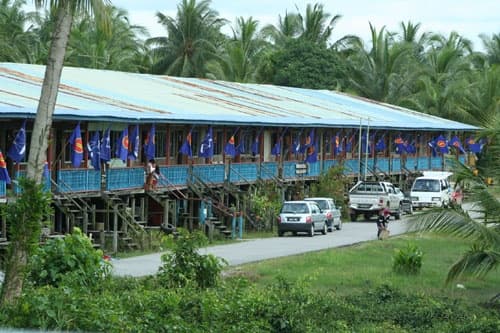
An Iban longhouse is easy to describe and hard to picture until you've stood inside one: a single timber-and-bamboo building raised on stilts, sometimes stretching hundreds of metres, holding an entire community under one continuous roof. The design breaks into three parts repeated the length of the building — the tanju, an open, unroofed deck out front for drying padi, chillies and laundry in the sun; the ruai, a wide covered veranda running the full length of the longhouse; and the bilik, the enclosed family apartments opening directly off the ruai, one per household. A longhouse can hold anywhere from a handful of doors to well over a hundred, each bilik home to an extended family.
Every longhouse operates under a tuai rumah, a headman chosen by the community rather than inherited by bloodline, whose job is part administrator and part mediator. Disputes, from boundary disagreements to marriage matters, are usually settled under adat, the Iban customary law that predates and still runs alongside Malaysia's formal legal system in many longhouse communities. Major decisions — hosting a festival, contributing labour to a shared project, resolving a conflict between households — tend to be worked out collectively on the ruai, in full view and earshot of whoever else happens to be sitting there that evening.
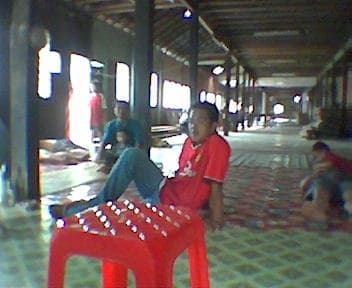
The ruai is where a longhouse actually lives. It functions simultaneously as street, living room, workshop and meeting hall — children play the length of it, elders sit mending fishing nets or weaving, and neighbours drift in and out of each other's doorways without knocking, since the ruai belongs to everyone. Days still largely follow the agricultural calendar: padi planting and harvest remain central for many households, alongside smallholdings of rubber and pepper that provide the cash income padi farming alone rarely does. Mornings start early and outdoors; by late afternoon, the ruai fills again as people return from the fields or from town.
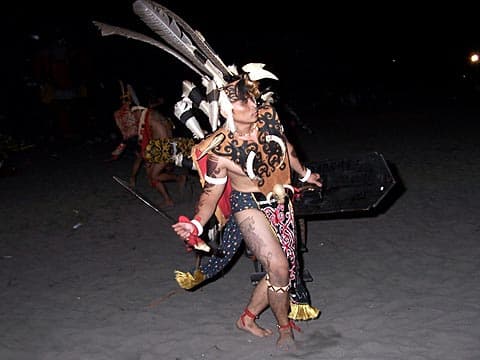
Births, weddings and funerals are communal events by default rather than by invitation — the whole longhouse is involved in some capacity, from cooking to hosting to simply being present. Gawai Dayak, the June harvest festival, is when this communal structure is most visible to outsiders: every bilik along the ruai opens its doors, tuak is poured continuously, and the ngajat is danced to welcome the year's blessings and any guest who walks in. It's the clearest possible illustration of what the longhouse model is actually for — a way of organising life so that celebration, grief and hard work are never carried by one household alone.
None of this has stood still. Solar panels and satellite dishes now sit on plenty of longhouse roofs, motorbikes are parked along the tanju, and younger residents commute to schools and jobs in nearby towns, sometimes returning only for festivals and weekends. Some communities have rebuilt in more modern materials — concrete stilts, zinc roofing — while keeping the ruai-bilik-tanju layout intact, proof that it's the social structure, not the building material, that actually defines a longhouse. Older all-timber longhouses still stand throughout the interior, often alongside these newer versions in the same river valley.
What's kept the Iban longhouse relevant for as long as it has isn't nostalgia — it's that the arrangement still solves a real problem: how dozens of related and unrelated families can share land, labour and risk without losing individual households in the process. Whether it's built from bamboo and belian hardwood or concrete and zinc, that basic logic, played out every evening along the ruai, hasn't really changed.