![Top left: Neocerambyx aeneus = Aeolesthes aurifaber (White, 1853) Top right: Megacriodes Saundersii = Batocera saundersii (Pascoe, 1866) Center: Diurus furcellatus [ sic ] = Diurus furcillatus Gyllenhal, 1833 Bottom left: Cladognathus tarandus = Cyclommatus tarandus (Thunberg, 1806) Bottom center: E](/_next/image?url=https%3A%2F%2Fupload.wikimedia.org%2Fwikipedia%2Fcommons%2F5%2F58%2FMalay_Archipelago_Beetles.jpg&w=1920&q=74)
Samarahan was the only place in Malaysia with air in the very unhealthy band at 8am on 7 September, at an Air Pollutant Index reading of 226, and no station anywhere in the country was in the hazardous band, Bernama reported from the Air Pollutant Index Management System. Four days earlier, Serian had read 391.
Sarawak is still the worst-affected state, with eleven stations in the unhealthy band. But the readings have now fallen back below every threshold that closes a school or grounds outdoor work, and the worst air in the state has shifted from the interior to the coastal corridor.
Where Sarawak's air stands this morning
The 8am table for 7 September put these eleven Sarawak stations between 101 and 200, the unhealthy band:
- Sarikei 194, in the Sarikei division
- IPD Serian 193
- Kuching 192, in the Kuching division
- Sibu 183
- Sri Aman 183, in the Sri Aman division
- Mukah 182
- Samalaju 179
- Bintulu 172, in the Bintulu division
- ILP Miri 169
- Miri 166
- Limbang 149, in the Limbang division
Only Samarahan sat above them. Nationally, 40 areas were unhealthy, 24 moderate and two good.
How far the numbers have fallen since 3 September
At 5pm on 3 September, the same stations looked very different. Serian was at 391, in the hazardous band. Kuching was 285, Sri Aman 275, Samarahan 274 and Sarikei 206 — four stations in the very unhealthy band at once, on Bernama's account of that afternoon's table.
By 8am on 6 September, Kuching had come down to 235 and Sri Aman to 216, with Samarahan then at 195. A day later Kuching had dropped a further 43 points and Sri Aman 33, while Samarahan rose by 31. The episode is retreating, but not evenly.
What each API number actually switches on
The index is not a description; it is a set of triggers. The Department of Environment's stated positions, as reported on 6 September, are that:
- outdoor activities are to be suspended when a reading exceeds 100;
- cloud seeding may be initiated when a reading passes 150 for more than 24 hours, weather permitting;
- schools close when readings exceed 200.
The school rule is the one Sarawak has already used this season. On 12 August, 108 schools in the Serian area were shut on the instruction of the State Disaster Management Committee, acting under the National Haze Action Plan through the director of the state education department, with remote learning continuing in place of classes. Serian had read 202 at 4pm that day. The committee's own wording is that schools, kindergartens and childcare centres close immediately once a reading reaches 200, as its statement put it; the environment department's formulation is that closures follow when readings exceed 200. The two-point gap has not mattered so far.
The bands themselves run 0 to 50 good, 51 to 100 moderate, 101 to 200 unhealthy, 201 to 300 very unhealthy, and above 300 hazardous, across the 68 monitoring stations that feed the system. The published figure is not an average: the Department of Environment calculates a sub-index for each of five pollutants and reports the highest of them, naming the pollutant responsible.
Why the smoke is no longer coming mostly from inside Sarawak
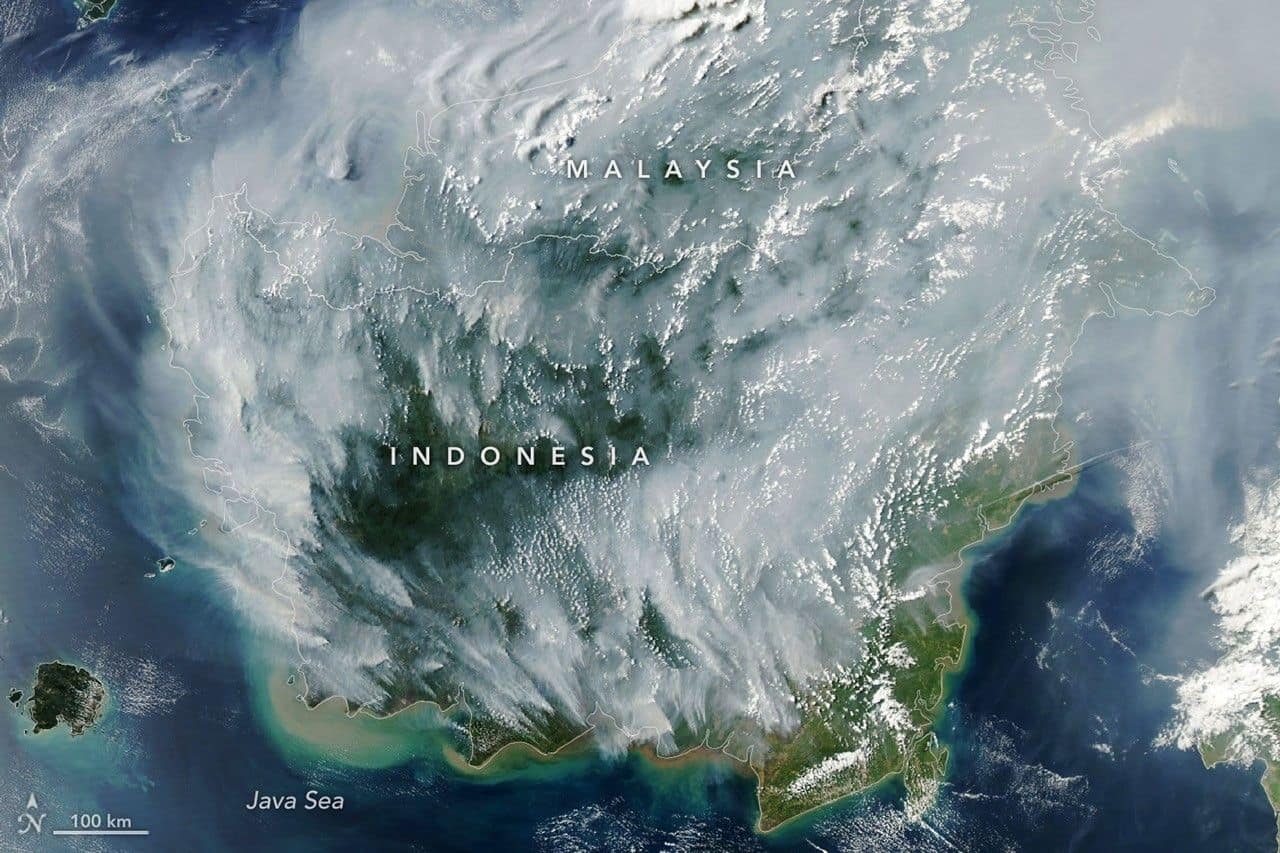
The source is across the border. Satellite imagery cited in the 3 September report detected 795 hotspots in Kalimantan and 144 in Sumatra, against three in the whole of Malaysia, all of them in Sarawak. The regional alert level for the southern part of Southeast Asia has been at level three since 27 August.
Sarawak's own fires are small by comparison but not absent. On 6 September the environment department was watching bush and peatland fires at two sites, in Mukah and in Daro, with nine hectares brought under control at one and roughly 2.5 of three hectares burnt at the other.
What is being done, and what would actually end it
On 24 August the natural resources minister, Datuk Seri Arthur Joseph Kurup, said Indonesia had cleared Malaysian cloud-seeding aircraft to cross its airspace to work border areas, and that Indonesia was deploying 1,500 additional armed forces personnel with high-capacity helicopters for water bombing, after talks with Indonesia's environment minister. Indonesia's disaster agency confirmed the arrangement four days later, saying the two countries had agreed to cooperate on prevention, monitoring and weather modification.
None of that removes the underlying condition. Cloud seeding needs cloud, and the readings will keep tracking the hotspot count upwind of Sarawak until the rain arrives on the Kalimantan side of the border.
Sources
- BERNAMA - Samarahan Only Area With ‘Very Unhealthy’ API Reading As Of 8 Am — Bernama
- BERNAMA - Air Quality Very Unhealthy In Kuching, Sri Aman At 8am — Bernama
- BERNAMA - Air Quality Deteriorates, Serian Records Hazardous API Reading Of 391 — Bernama
- BERNAMA Radio - JEREBU: 108 SEKOLAH DI SERIAN DITUTUP SUSULAN IPU MELEBIHI 200 — Bernama
- BERNAMA - Transboundary Haze: 11 Areas In Sarawak Record Unhealthy API Readings — Bernama
- BERNAMA - Malaysia, Indonesia Ramp Up Measures To Tackle Haze Ahead Of National Day - Arthur — Bernama
- BERNAMA - Haze: Indonesia Says Coordinating With Malaysia On Weather Modification — Bernama
- (English) Air Pollutant Index (API) - Department of Environment — Department of Environment Malaysia