In Sarawak a basket is a tool before it is a souvenir. The Sarawak Museum Department's account of the state's plaiting arts sets out a distinct form for each stage of the padi year, and further types cut for gathering, for fishing and for carrying personal effects. The shape follows the job, and the job is agricultural.
What the shapes are actually for
The department lists the raw materials as rattan, bamboo, nipah leaves, pandanus palms and bemban reed — all gathered rather than bought. Some plaited items are not domestic at all, but carry meaning in ritual.
- Carriers — back-borne baskets for moving produce, sometimes over long distances
- Containers — storage for padi and for personal belongings inside the longhouse
- Field tools — separate baskets for sowing, for the harvest and for winnowing, and others for bamboo shoots, edible ferns and fishing
- Headgear — hats worked to keep sun and rain off a farmer
- Mats — for sleeping, for sun-drying padi, and for farming festivals and rites
How to tell a Penan basket from a Bidayuh one
The forms are ethnically specific, and the department describes them individually. The nomadic Penan are noted for closely plaited rattan sleeping mats and baskets, soft and pliable, worked in a pale ground with dark brown or black hornbill, spider and floral motifs; their best-known basket is the ajat, a cylindrical rattan backpack with two shoulder straps. The Kayan ingan is cylindrical too, made from wide rattan strips, flared slightly at the top and standing on four vertical side sticks.
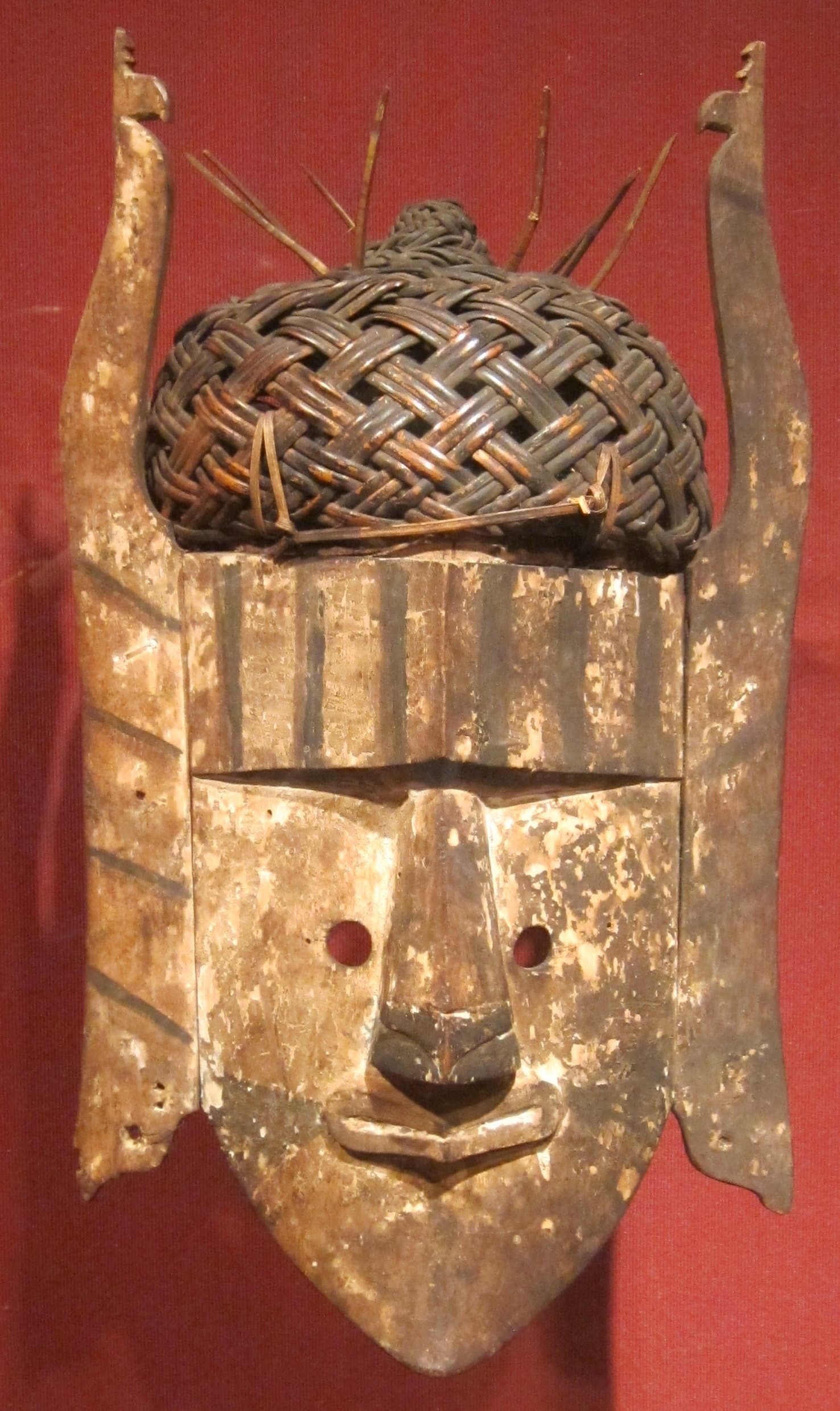
The Bidayuh tambok resembles it, carried on the back with a bark-cloth strap across the forehead — but it is plaited with vertical and horizontal strips rather than the diagonal work used by other groups, which is the single clearest way to tell one apart. The Bidayuh chantong, finely plaited and fitted with a drum-like cover, was where taken heads were kept when headhunting was still practised.
Coastal Melanau work runs from the round-topped Rejang basket to purses and handbags in natural, black and red, in thin rattan or bemban strips; the same group makes the broad conical terendak hat from swamp nipah leaves, its rim strengthened with sewn rattan. Iban seed baskets, called raga, stand about ten inches high with a white wooden band at the rim and no stick supports, and are worn at shoulder or waist so seed can be drawn out while planting. Kelabit padi baskets are large and cone-like, banded with designs tied to padi growing.
Skill here was social currency: the department records that among the Iban, a woman able to plait finely gained standing in her community.
Who runs craft in Sarawak, state and federal
Two bodies sit over the sector, one state and one federal, and they are easy to confuse. The Sarawak Craft Council is listed in the state government directory at Blok D4 and Blok F of the Sarawak Tourism Complex on Jalan Tun Abang Haji Openg in Kuching, recorded there under the non-governmental organisation category. Separately, the Perbadanan Kemajuan Kraftangan Malaysia branch for Sarawak is listed as a federal statutory body, at Jalan Stadium in Petra Jaya.
The Ministry of Tourism, Creative Industry and Performing Arts names the Craft Council, the Sarawak Museum and the Sarawak Tourism Board among the bodies it works alongside, and sets its own arts remit as performing arts services, state ceremonial programmes, previews for foreign artistes and documenting traditional dance and music.
The ministry also administers a grant, Dana Mudahcara Warisan dan Kesenian Sarawak. Its published application set is a guidelines document, a checklist, a form and an integrity pact; the ceilings and eligibility rules sit inside those downloads rather than on the page, which lists three officers for enquiries.
What the weaving actually earns
Bernama reported in June 2026 on the Nanga Sumpa Handicraft Association in Lubok Antu, whose representative Jani Muking, 49, said the group's display — gaga and raga baskets, a bemban handbag, the tied-technique seluk and the rattan sintung — stood for the work of roughly 30 longhouse women. Sales normally depend on tourists reaching the Nanga Sumpa homestay; Sarawak Energy sponsorship took the goods to a Kuala Lumpur festival for the first time. That is the structural problem in one line: the market has to travel to the longhouse.
The state's answer has been to move the goods instead. The Craft Council ran the BorneoCraft Global Expo and Conference at the Kuching Waterfront from 27 November to 1 December 2024, with a conference, a MasterCraft Challenge and a public marketplace, pitched as a route for artisans into e-commerce, according to Bernama. Earlier, at London Craft Week in May 2023, Sarawak showed songket, keringkam embroidery, pua kumbu weaving, bead embroidery and basket and mat work, and launched saratage.my as an online outlet.
Where the collections are, and what is shut
The Sarawak Textile Museum in Kuching occupies a building put up in 1907 as a medical centre, later the education department's office, and converted in August 2000; it holds Iban pua kumbu and Kain Songket Melayu Sarawak, hung to follow cloth from yarn to finished length. Check before travelling: the department's page carries a temporary closure notice for maintenance, with no reopening date. The basketry page, dated September 2016, notes that baskets, hats and mats are sold through the museum shop.
Sources
- Arts and Culture - Ministry of Tourism, Creative Industry & Performing Arts Sarawak — Sarawak Government
- Dana Mudahcara Warisan dan Kesenian Sarawak - Ministry of Tourism, Creative Industry & Performing Arts Sarawak — Sarawak Government
- TALIKHIDMAT — Sarawak Government
- TALIKHIDMAT — Sarawak Government
- BERNAMA - Women Of Interior Sabah, Sarawak Continue To Empower Traditional Heritage Handicraft — Bernama
- BERNAMA - BorneoCraft Global Expo, Conference In Kuching Starting Nov 27 — Bernama
- BERNAMA - Sarawak Collaborates With Varous Agencies To Promote Heritage Crafts — Bernama
- Basketry - Sarawak Museum Department — Sarawak Government
- Sarawak Textile Museum - Sarawak Museum Department — Sarawak Government