Sarawak is home to more than forty ethnic groups, and its identity is stitched together like a pua kumbu — each pattern a story of river, forest and community carried across generations. The largest indigenous group is the Iban, alongside the Bidayuh, the Melanau, the Orang Ulu peoples of the interior, and the Chinese and Malay communities of the coast and the towns. None of this is museum history: the longhouses are lived in, the textiles are still woven, and the festivals are household events.
Living Heritage
The heritage of Sarawak
More than forty ethnic groups, a textile that is dreamt before it is woven, and a hundred years of Brooke rule — all still visible.
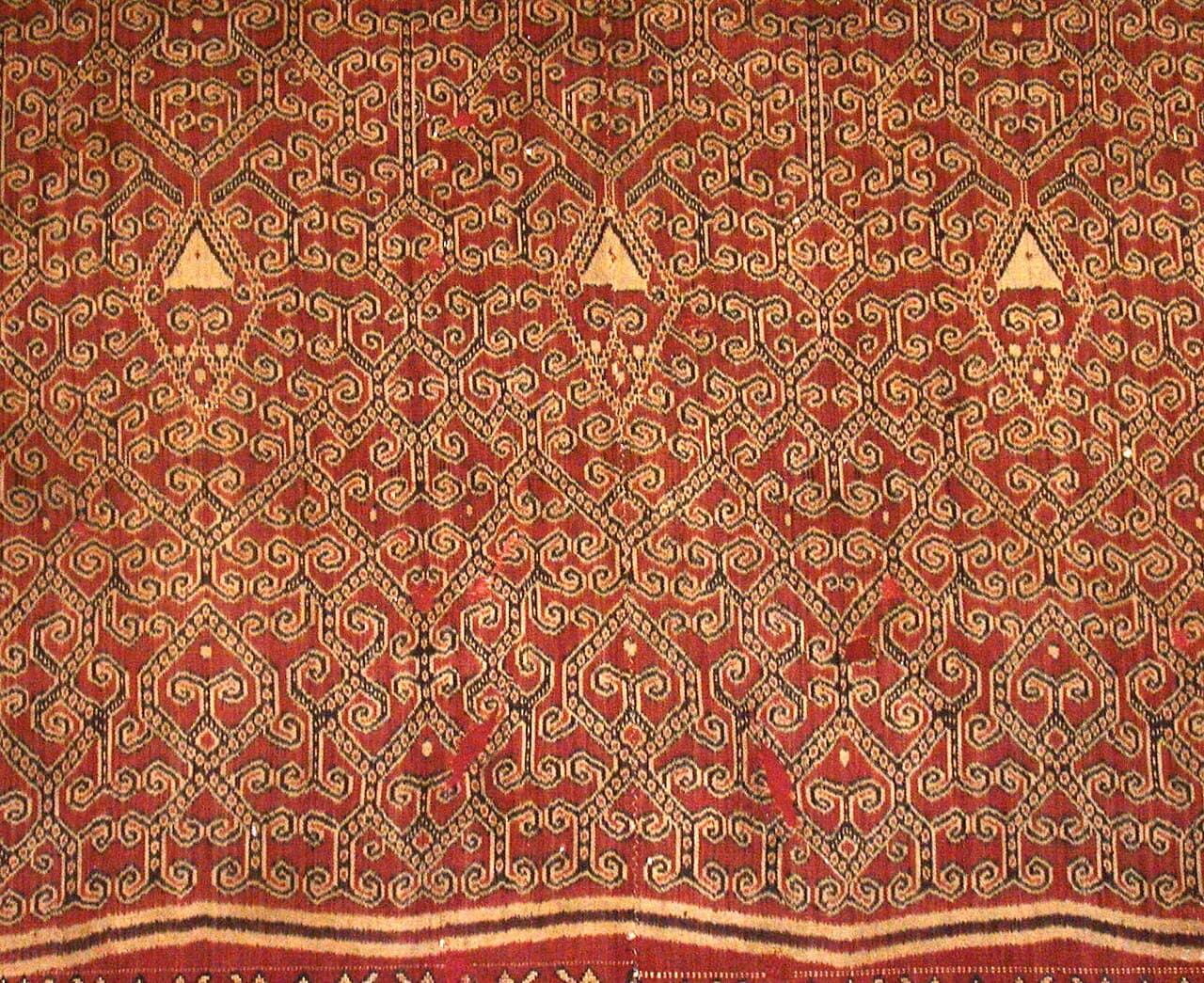
Pua Kumbu · Iban Ikat
The Metropolitan Museum of Art · CC0
The art of the weave
Pua kumbu is the sacred ikat textile of the Iban, and the phrase people use for it is that it is dreamt before it is woven: the motifs are understood to come to the weaver rather than being designed. The threads are tied and dyed before they ever reach the loom, so the pattern exists in the bundle before it exists in the cloth.
Read the full story of pua kumbu — the motifs, the dye, the master weavers and what the cloth is actually for.
Longhouses
A longhouse is a village under one roof. The ruai is the long communal gallery that runs the length of the building and functions as street, meeting hall and living room at once; the bilik behind it is each family’s private apartment; the tanju is the open veranda where padi is dried. Our piece on life inside an Iban longhouse walks through how dozens of families actually share that space day to day, and community, ritual and pua kumbu covers what holds it together.
Bidayuh longhouses are built differently again — usually on hillsides rather than riverbanks, and traditionally paired with a baruk, the round headhouse that served as the community’s ceremonial building. Annah Rais, about an hour from Kuching, is the most accessible example. If you are planning to visit any longhouse, read the first-timer’s guide first: the etiquette matters more than the logistics.
The Melanau coast
Along the coast around Mukah, the Melanau built a culture on the sago palm — a starch crop processed into flour and pearls that underwrote the whole regional economy long before oil did. The Melanau tall houses, once raised on enormous stilts as a defence, are the architectural signature of that coast, and umai, the raw-fish salad cured in lime, is its best-known contribution to the Sarawak table.
The Brooke century
From 1841 Sarawak was ruled by three generations of the Brooke family, the “White Rajahs” — an arrangement with no real parallel anywhere else. The physical evidence is still standing: Fort Margherita, built in 1879 on the north bank of the Sarawak River, now houses the Brooke Gallery, and the Astana across the water from the Kuching waterfront was built as the Rajah’s residence. Further north, Canada Hill in Miri holds the Grand Old Lady, the oil well that began Malaysia’s petroleum industry in 1910 and changed the state’s economy for good.
Where to see it
The Borneo Cultures Museum in Kuching is the single best starting point — five floors, and the largest museum in Malaysia. The Sarawak Cultural Village at Damai takes the opposite approach: seven traditional houses built at full scale in a rainforest cove, each staffed by people from the community it represents, and the home of the Rainforest World Music Festival every July.
Heritage in Sarawak is easiest to encounter at Gawai, when longhouse doors are open to anyone who walks up. That is a genuine invitation, and it is worth taking seriously enough to arrive prepared.
Heritage places to visit
 Damai, Santubong PeninsulaSarawak Cultural VillageSarawak's living museum — seven traditional houses, one rainforest cove, and the home of the Rainforest World Music Festival.
 KuchingBorneo Cultures MuseumMalaysia's largest museum — five floors of Borneo's story, in a striking golden landmark in central Kuching.
 KuchingFort Margherita & the Brooke GalleryThe 1879 riverbank fortress of the White Rajahs — now home to the Brooke Gallery's swashbuckling history.
 Petra Jaya, KuchingKuching Cat MuseumThousands of feline treasures on a hilltop in the world's 'Cat City' — quirky, charming and unique.
 MiriCanada Hill & the Grand Old LadyMalaysia's first oil well atop Miri's sunset ridge — where the nation's petroleum story began in 1910.
 Kuching DivisionThe AstanaThe 1870 riverside palace built by Charles Brooke for his bride — still the Governor's residence, and still best seen from the water.
 Kuching DivisionThe Square TowerAn 1879 fortified tower on the Waterfront that has been a prison, a fortress, a dance hall and a lookout — and that almost everyone walks straight past.
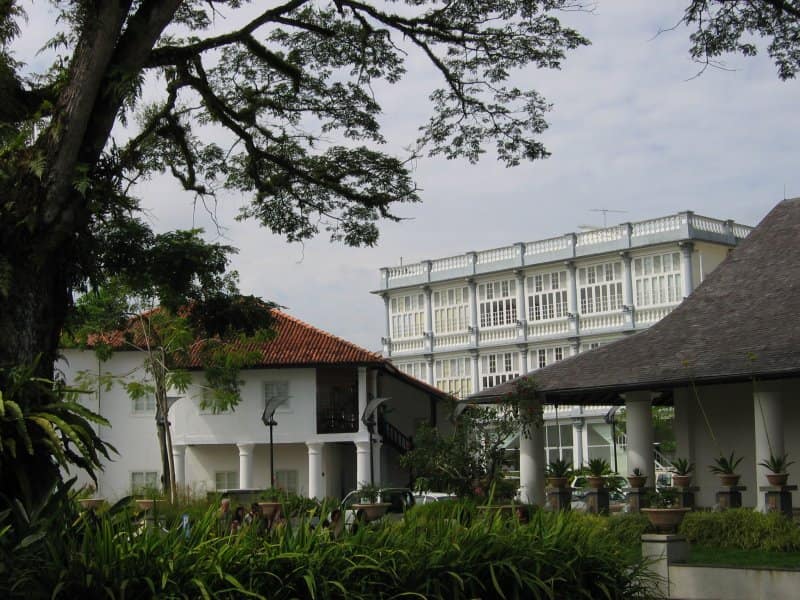 Kuching DivisionThe Old CourthouseThe 1874 seat of Brooke justice, its colonnades and belian roof now sheltering cafes, galleries and Kuching's evening crowd.
 Kuching DivisionSarawak State Legislative AssemblyThe golden nine-sided roof across the river — a modern building shaped from the terendak, the Malay sunhat, and now Kuching's defining silhouette.
 Kuching DivisionIslamic Heritage MuseumSeven galleries of Islamic art, science and Southeast Asian history in a restored Malay college building — the quiet standout of Kuching's museum precinct.
 Sri Aman DivisionFort AliceThe best-preserved of the Brooke outstation forts — a belian-timber stockade of 1864, restored and reopened as a heritage museum.
 Sibu DivisionFort EmmaThe 1859 Brooke fort at the meeting of the Rejang and the Kanowit, named for the Rajah's sister and still standing over the confluence.
 Kuching DivisionIndian Mosque (Masjid India)Sarawak's oldest mosque, built of belian in 1837 and reached down a two-foot alley between shophouses — the most easily missed building in Kuching.
 Kuching DivisionSt Thomas's CathedralThe oldest Anglican foundation in Borneo, on a green hill above the old town, with a churchyard that reads as a register of early Sarawak.
 Sibu DivisionTua Pek Kong Temple & Seven-Storey PagodaSibu's riverfront temple and its seven-storey pagoda — climb it for the best view there is of the Rejang running past the town.
 Sibu DivisionLau King Howe Hospital Memorial MuseumMalaysia's only medical museum, in the surviving block of the hospital a Foochow merchant funded for a town that had none.
 Bintulu DivisionTamu Bintulu & Pasar UtamaBintulu's twin markets — jungle produce and river fish under one roof, and the oldest continuously running institution in town.
Culture & Heritage
Keep reading
Pua kumbu photograph: The Metropolitan Museum of Art (CC0), via Wikimedia Commons. Place photographs credited on each place page.